
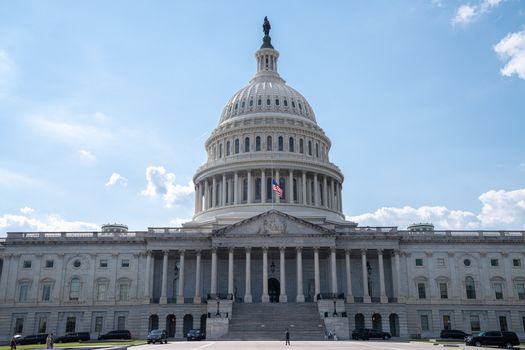
The Trump administration’s decision to pursue a $70 billion immigration enforcement funding package through the budget reconciliation process has transformed the legislative calendar into a rigid test of executive and party efficacy. With a June 1, 2026, deadline set by the President for the package to reach his desk, we are entering a critical window where legislative momentum—or the lack thereof—functions as an immediate proxy for administration stability.
The Reconciliation Trigger
The resolution of the 76-day Department of Homeland Security (DHS) funding lapse on April 30, 2026, did not end the conflict; it merely compartmentalized it. By adopting a two-track strategy, congressional leadership successfully decoupled non-controversial DHS components (TSA, FEMA, Coast Guard) from the highly contentious funding for Immigration and Customs Enforcement (ICE) and Customs and Border Protection (CBP). The latter remains on the party-line reconciliation track, with a June 1 "hard trigger."
This is not a routine legislative deadline. President Trump has explicitly linked the administration’s operational success to the passage of this package. Because the Senate filibuster is bypassed via reconciliation, the burden of proof rests entirely on the House Republican conference. With a razor-thin majority and a deeply fractured membership, Speaker Mike Johnson’s ability to whip the conference toward near-unanimity on H.R. 1 will be the defining metric of his speakership over the next month.
The Cabinet Scapegoat Dynamic
The administration’s history suggests that cabinet-level turnover is the preferred response to legislative stalemate. Previous departures of high-profile officials like Kirstjen Nielsen and Jeff Sessions were preceded by clear indicators: presidential frustration, tactical frustration in the courts, and congressional inertia.
We should distinguish between two types of potential departures:
- Forced Political Necessity: If the June 1 deadline is missed, the administration will require a high-profile scapegoat to redirect political energy. DHS Secretary Markwayne Mullin, while currently holding no public indicators of an imminent exit, sits at the center of this risk. A failure to secure the funding he described as critical for avoiding operational collapse would place him in a position of perceived failure.
- Preemptive Resignation: Cabinet officials who recognize that the House is incapable of bridging the gap between its hardline Freedom Caucus and its pragmatic moderates may choose to distance themselves from a "failed" legislative outcome. Given the DOJ's recent volatility—evidenced by the ouster of Attorney General Pam Bondi—officials are increasingly aware that their tenure is tied to their ability to navigate the administration's aggressive legislative timelines.
Counter-Arguments and Risks
It is possible that the administration could pivot to administrative actions or executive orders to bypass the reconciliation route, or that Speaker Johnson achieves a watered-down deal that, while less comprehensive than initially promised, allows for a declaration of victory. However, the President’s branding of the June 1 deadline creates a "all-or-nothing" perception that makes a partial win politically difficult to sell.